
Tools and project management · Informal economy series
Fintechs and the economically invisible
Case studies and a map of solutions for micro-businesses and informal workers
Series "The informal sector, SMEs and the economy in Africa", article 8 of 11
This article builds on the argument I make in "Should we really formalize the informal sector?": rather than forcing the informal sector to formalize, integrate it, starting from what it already does.
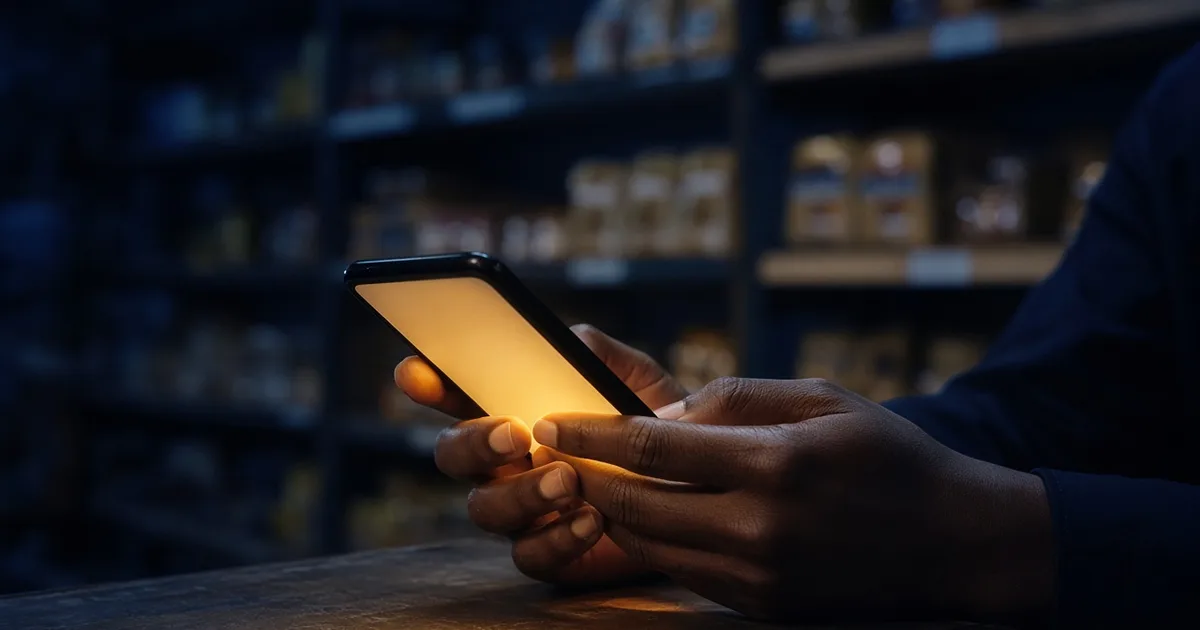
At the market, the trader has no bank account, but she has a phone. She takes payments, sends money, receives it, pays back what she owes. Without knowing it, she writes her financial history every day. The bank cannot see her; her phone can. The question is who will read that history, on what terms, and whether it will work for her or against her.
Introduction: the bank does not talk to everyone
Millions of Africans remain invisible to traditional banks: small traders, day labourers, rural women, young people with no steady income, micro-businesses with no banking history. No formal income, no collateral, no track record: some fintechs are trying to fill that gap with simple mobile tools. If collecting the contribution and delivering the rights it opens are to go through the phone, we first need to know who is doing what today, for whom, and with what results.
I. Banks stood still, phones moved ahead
Figures from the Central Bank of West African States (BCEAO) sum up the paradox. In 2024, in the WAEMU, the strict bank account ownership rate was 25.2%, down slightly on 2023. But the overall rate of use of financial services reached 73.6%, driven, according to the BCEAO itself, by e-money services, the "main vehicles of financial inclusion" in the zone (BCEAO, 2026).
Inclusion remains uneven. In sub-Saharan Africa, 52% of women had an account in 2024, against 64% of men, a 12-point gap, the second largest in the world (World Bank, 2025; see my article "Women of the informal sector: from the Gouro market to equal access"). On top of the familiar obstacles (cost, distance to branches, procedures, mistrust), micro-businesses face their own constraints: irregular cash flow, little collateral, reliance on cash. Without an account, saving is hard; without savings, there is no credit; and without credit, a small business stays small.
Box: the economically invisible and their five needs A qualitative survey of mobile credit users carried out in Abidjan in May 2025 describes budgets "shaped by irregular income, multiple jobs and heavy exposure to shocks". Mobile credit, loans between relatives and friends, and savings all exist side by side: tontines, associations, mobile money "safes", money left with someone close, or cash put aside. Most of the people interviewed had never had access to bank credit or to microfinance loans (Ducourant, 2026). Their needs come down to five verbs: get paid (customer payments, without loss or theft); save (put money aside, even a little, even every day); borrow (short-term working capital, to buy stock); insure (against illness, accidents, a fire at the stall); keep count (know what you really earn). This five-verb grid is my own synthesis, not a statistic.
II. What makes a fintech inclusive?
An inclusive fintech offers simple financial services to people the banks do not serve: services designed for mobile, including basic phones through USSD codes; micro-payments, savings, credit, insurance; low costs; simple interfaces, sometimes in local languages. The best ones start from the field and work towards the tool, not the other way round: they watch how people already pay, save and borrow, then digitize those habits.
III. Three case studies from West Africa
A. Wave (Senegal, Côte d’Ivoire): the price war
Launched in Senegal in 2018, Wave imposed a 1% fee on person-to-person transfers, against a historical range of 6 to 10%, with a simple app and highly visible marketing (GSMA, 2024). Today it advertises free deposits and withdrawals and transfers at 1% (Wave, n.d.). The effect on prices is documented: in Senegal, the incumbent operators cut their fees to 1% (GSMA, 2024); at the end of November 2021, Orange Money even scrapped its withdrawal fees and set its sending fee at 0.8% (Velluet, 2021).
The downsides are just as well documented. Lower fees cut agents’ commissions: some Orange Money agents in Senegal reported losing 50% of their income; in Côte d’Ivoire, agents went on strike for several days in August 2022 (GSMA, 2024). Their unions, in fact, were targeting the incumbent operators more than Wave, accusing them of paying, for more than a decade, commissions "which already did not allow us PDVs (point-of-sale owners) to make a decent living from our work" (KOACI, 2022). Finally, a 15% cut in its workforce led Wave to scale back its operations in Mali, Burkina Faso and Uganda. The GSMA questions whether a 1% model funded by venture capital can last (GSMA, 2024). A useful caveat: the GSMA represents the operators, Wave’s direct competitors; its conclusions are those of an interested party, even if the facts it cites can be checked. Without independent data, I give no user numbers for Wave.
B. Moniepoint (Nigeria): lending on real cash flows
Moniepoint offers SMEs and micro-businesses an integrated package: payment terminals, business accounts, credit. Its key innovation fits in one rule: only entrepreneurs whose business account has been active for at least six weeks, and who use it regularly for all their transactions, can apply for a loan (Moniepoint, n.d.). Credit no longer rests on collateral or a balance sheet, but on observed cash flows. This is exactly the logic to apply to the contribution: regular payments build a history, and that history opens rights.
C. Orange Bank Africa (Côte d’Ivoire): microcredit in the mobile wallet
Orange Bank Africa offers the Tik Tak loan directly in the Orange Money app. You must have been an Orange Money customer for at least six months; the amount offered depends on how the account is used (bill payments, transfers, withdrawals) and on savings. For loans of 5,000 to 50,000 CFA francs over one month, the advertised cost is 1.15% before tax, plus 2,400 CFA francs before tax per year for access to digital services; after three days late, a 10% penalty applies and the borrower can be reported to the credit bureau (Orange Bank Africa, n.d.). In 2023, the International Finance Corporation (IFC) announced a 50% guarantee on a portfolio of digital loans to MSMEs worth up to the equivalent of 30 million dollars, with a target of about 300,000 additional loans by 2025, particularly in rural and underserved areas (IFC, 2023). That was a target; as far as I know, no results have been published.
Box: the three solutions compared
| Wave | Moniepoint | Orange Bank Africa | |
|---|---|---|---|
| Countries | Senegal, Côte d’Ivoire, others | Nigeria | Côte d’Ivoire |
| Main service | Transfers, payments, deposits and withdrawals | Accounts, payment terminals, business credit | Microcredit and savings through Orange Money |
| Access | Free deposits and withdrawals, transfers at 1% | Account active for 6 weeks to borrow | Orange Money customer for 6 months |
| Innovation | Price disruption | Cash-flow-based credit | Amount based on mobile usage |
| Target users | Individuals, traders | SMEs, micro-businesses | Individuals, traders, MSMEs |
| Watch-out | Agents’ income, sustainability | Concentrated in Nigeria | Late-payment penalties, credit blacklisting |
Sources: GSMA (2024); Wave (n.d.); Moniepoint (n.d.); Orange Bank Africa (n.d.); IFC (2023).
IV. Mapping: who does what?
This map is not exhaustive. It describes services as the companies themselves present them; it is not an impact assessment.
Table: a map of solutions serving micro-businesses and informal workers
| Fintech | Countries | Main service | Target | Notable point |
|---|---|---|---|---|
| Wave | Senegal, Côte d’Ivoire… | Payments, transfers | Individuals, traders | 1% fee (see III.A) |
| Paystack | Founded in Nigeria | Online payments | Merchants, businesses | A Stripe company |
| Paga | Nigeria | Payments; Doroki management app for SMEs | Individuals, SMEs | Payment infrastructure for third parties |
| Moniepoint | Nigeria | Accounts, terminals, credit | SMEs | Credit based on real cash flows (see III.B) |
| Orange Bank Africa | Côte d’Ivoire | Microcredit, savings | Orange Money customers | Tik Tak loan (see III.C) |
| JUMO | Several African countries | Credit and savings infrastructure | Banks, mobile operators | White-label technology |
| Numida | Uganda | Working capital loans through an app | Micro-businesses 6 months old or more | Interest of 13 to 25% per month |
| Izili (formerly Baobab+) | Senegal, Côte d’Ivoire, Nigeria, Madagascar | Solar kits and digital devices on credit | Households, entrepreneurs | 425,000 households equipped (self-reported) |
| Oze | Ghana, Nigeria, Rwanda, Madagascar | Bookkeeping, invoices, inventory; access to credit | Micro-businesses, SMEs | Management and credit linked |
| Turaco | Kenya, Uganda | Embedded health and life micro-insurance | Partners’ clients (microfinance) | Premiums from $0.50 a month |
| MaTontine | Senegal | Digital tontine and credit | Tontine members, mostly women | 3% default rate during the pilot |
Sources: company websites consulted in October 2026 (Paystack, n.d.; Paga, n.d.; JUMO, n.d.; Numida, n.d.; Oze, n.d.); BioLite (2025) for Izili; ASA International (2025) for Turaco; Murthy and Fernandez-Vidal (2019) for MaTontine.
Two examples stand out. In Senegal, MaTontine digitized the tontine without replacing it: during a six-month pilot, it signed up 1,047 members in 62 tontines, 95% of them women, and lent to 602 of them; the default rate stayed at 3%, but rose to 8% in groups where members did not know each other (Murthy and Fernandez-Vidal, 2019). Social trust is still the best collateral. Turaco, working with the microfinance institution ASA International, builds life and hospital insurance into loan disbursement, with premiums from 0.50 dollars a month, in Kenya and Uganda (ASA International, 2025): the insurance comes with no extra paperwork.
V. What fintechs really change, and where
Risk is redefined. Moniepoint and Orange Bank Africa assess borrowers on their cash flows and mobile usage rather than on their collateral.
Transaction costs are falling. The drop from 6-10% to 1% on transfers in Senegal is the clearest proof (GSMA, 2024).
Public infrastructure is catching up. On September 30, 2025, the BCEAO launched the interoperable instant payment platform (PI-SPI), available around the clock in all eight WAEMU countries, with a standardized merchant QR code; among its uses, it explicitly cites paying social benefits and collecting taxes (BCEAO, 2025).
The map is still uneven. Most of the players mentioned were born in Nigeria or East Africa; French-speaking West Africa is advancing mainly through partnerships.
This is where fintech meets the third lever I argue for in "Should we really formalize the informal sector?": a contribution paid regularly by phone could, with the entrepreneur’s explicit consent, strengthen their credit profile. Paying then becomes an investment: every payment brings the first loan a little closer.
VI. The cure-all mirage
Every case made for African fintech cites the same study, published in Science: it estimates that access to M-Pesa lifted about 194,000 Kenyan households out of poverty, or 2% of the total, notably women who moved from farming into business (Suri and Jack, 2016). The figure, which went around the world, is hotly disputed. Milford Bateman, Maren Duvendack and Nicholas Loubere call the analysis "extremely problematic": no control group to attribute the gains to M-Pesa rather than to the general trend of the economy, and no account taken of micro-business failures, over-indebtedness or the risks pushed onto the poorest (Bateman, Duvendack and Loubere, 2019).
Their strongest objection speaks directly to the informal economy: the displacement effect. When mobile money pushes newcomers into petty trade without local demand growing, they take customers from the women traders already there; the net gain in jobs and income can then be small, or close to zero (Bateman, Duvendack and Loubere, 2019). Ten more stalls in a market with no more customers is not development: it is sharing scarcity. That is why this series never treats fintech as an end in itself, but as the tool of a policy that must also act on demand, productivity and market outlets.
VII. Limits and challenges
The cost of credit varies enormously. Over one month, the Tik Tak loan costs 1.15% before tax and before annual fees (see above); the M-Shwari loan in Kenya, a 7.5% fee for 30 days (Safaricom, n.d.); a Numida loan in Uganda, 13 to 25% interest per month (Numida, n.d.). Annualized without compounding, 7.5% a month already comes to 90%. Quick credit can save a stock of goods; it can also trap people in debt if scores are poorly calibrated and the terms poorly understood.
Regulation is running behind innovation. Legal statuses remain hybrid, somewhere between bank, e-money institution and telecom operator, and frameworks vary from country to country. Interoperability is improving, with PI-SPI, but it depends on every provider actually connecting, which the BCEAO is still calling for (BCEAO, 2025). The players are fragile: in Kenya, the buy-now-pay-later fintech Lipa Later was placed in administration on March 24, 2025, after failing to raise new funds (Abuya, 2025). Personal data, finally, is the flip side of credit scoring: I devote my article "Beyond mobile money: economic inclusion, data and trust" to it.
Fintechs on trial
"Fintechs are private companies chasing profit, not inclusion." True, and that is not a flaw in itself: Wave brought prices down faster than any public policy. But profit can also come from double-digit monthly rates, or from squeezing vulnerable agents. Hence the need for clear rules on cost transparency, with costs stated as an annual rate, and for a public-private partnership in which the state sets the framework and fintechs innovate.
"Plugging the contribution into mobile makes the state dependent on private operators." Fair point: a collection monopoly would be dangerous, and taxing transactions can itself drive people back to cash, as Ghana’s E-Levy showed (see my article "Rethinking taxation of the informal sector: a single variable-rate contribution, a flat fee and gradual steps"). Hence multichannel, interoperable payment, built on the public PI-SPI infrastructure, and no tax on transactions: the contribution is paid by phone, not deducted from every payment.
Conclusion: a bank for the invisible is here, but it still has to be built
Fintechs are not a miracle cure, but they are an essential link: they need support, smart regulation and a connection to public policy, starting with the contribution and the social rights proposed in this series.
Because a mobile account is not an economic transformation. How many of these accounts are really used? Who owns the data they generate? And how do we build the trust without which nothing holds?
Also in this series: "Beyond mobile money: economic inclusion, data and trust". From access to use, and from use to transformation, without sacrificing data protection.
References
Abuya, K. (2025, March 27). "Lipa Later enters administration after failed fresh fundraising efforts". TechCabal. https://techcabal.com/2025/03/27/lipa-later-enters-administration/
ASA International (2025, May 7). "Microinsurance Launch: Expanding Access to Insurance Across our African Markets". https://www.asa-international.com/media/featured-news/microinsurance-launch/
World Bank (2025). The Global Findex Database 2025, sub-Saharan Africa regional summary (FinDev Gateway). https://www.findevgateway.org/region/financial-inclusion-sub-saharan-africa
Bateman, M., Duvendack, M. and Loubere, N. (2019). "Is fin-tech the new panacea for poverty alleviation and local development? Contesting Suri and Jack’s M-Pesa findings published in Science". Review of African Political Economy, 46(161). https://doi.org/10.1080/03056244.2019.1614552
BCEAO (2025, September 30). « Lancement officiel de la Plateforme interopérable du système de paiement instantané (PI-SPI) de l’UEMOA ». https://www.bceao.int/fr/content/lancement-officiel-de-la-plateforme-interoperable-du-systeme-de-paiement-instantane-pi-spi
BCEAO (2026). Rapport sur la situation de l’inclusion financière dans l’UEMOA au cours de l’année 2024. https://www.bceao.int/sites/default/files/2026-06/Rapport_Annuel_Inclusion_Financiere_2024.pdf
BioLite (2025, May 6). "Baobab Group Completes Strategic Sale of Majority Stake in Baobab+ to BioLite". https://www.bioliteenergy.com/blogs/press/baobab-group-completes-strategic-sale-of-majority-stake-in-baobab-to-biolite
Ducourant, H., with Beauvisage, T. and Gire, F. (2026, September 1). « “Et clic, l’argent est là” : les usages du crédit digital en Côte d’Ivoire ». The Conversation. https://theconversation.com/et-clic-largent-est-la-les-usages-du-credit-digital-en-cote-divoire-290006
GSMA (2024). Disruption vs. sustainability: Lessons from mobile money in West Africa. March 2024. https://www.gsma.com/solutions-and-impact/connectivity-for-good/mobile-for-development/wp-content/uploads/2024/03/Disruption-vs-sustainability_-Lessons-from-mobile-money-in-West-Africa.pdf
IFC (2023, July 4). "IFC Partners with Orange Bank Africa to Increase Digital Lending for Small Businesses in West Africa". https://www.ifc.org/en/pressroom/2023/ifc-partners-with-orange-bank-africa-to-increase-digital-lending-for-small-businesses-in-west-africa
JUMO (n.d.). Official website. https://jumo.world
KOACI (2022, August 15). « Côte d’Ivoire : Mobile money, après une semaine de grève, les acteurs et propriétaires lèvent leur mot d’ordre de grève, mais campent sur leurs revendications ». https://www.koaci.com/index.php/article/2022/08/15/cote-divoire/societe/cote-divoire-mobile-money-apres-une-semaine-de-greve-les-acteurs-et-proprietaires-levent-leur-mot-dordre-de-greve-mais-campent-sur-leurs-revendications-ce-quils-prevoient_162418.html
Moniepoint (n.d.). "Who is eligible to apply for a business loan?". https://support.moniepoint.com/topics/loans-225/who-is-eligible-to-apply-for-a-business-loan-317
Murthy, G. and Fernandez-Vidal, M. (2019). Fintechs and Financial Inclusion: Lessons Learned. CGAP. https://www.cgap.org/sites/default/files/publications/2019_05_Case_Study_Fintech_and_Financial_Inclusion.pdf
Numida (n.d.). "FAQs", Uganda. https://ug.numida.com/faqs/
Orange Bank Africa (n.d.). « Le prêt Tik Tak ». https://orangebank.ci/pret-tiktak-classique
Oze (n.d.). Official website. https://getoze.com
Paga (n.d.). Official website. https://paga.com
Paystack (n.d.). Official website. https://paystack.com/countries
Safaricom (n.d.). "M-Shwari FAQs". https://www.safaricom.co.ke/media-center-landing/frequently-asked-questions/m-shwari-faqs-safaricom
Suri, T. and Jack, W. (2016). "The long-run poverty and gender impacts of mobile money". Science, 354(6317), 1288-1292. https://doi.org/10.1126/science.aah5309
Velluet, Q. (2021, December 13). « Cheikh Tidiane Sarr (Orange Money Sénégal) : “Avec Wave, l’équilibre des prix a été brutalement rompu” ». Jeune Afrique. https://www.jeuneafrique.com/1279167/economie-entreprises/cheikh-tidiane-sarr-orange-money-senegal-avec-wave-lequilibre-des-prix-a-ete-brutalement-rompu/
Wave (n.d.). Official website. https://www.wave.com/fr/
Get my free guide Investir et entreprendre en Côte d'Ivoire (in French).
Get the guide Let's talk about your projectFurther reading
Should we really formalize the informal sector?
Three levers, built on fintech, to turn Africa’s grassroots economy into an engine of development
· 13 min read

Informality in a suit and tie
When formal does not mean structured
· 12 min read